
Septic Tank Cleaning in Ireland: The 2026 Homeowner’s Guide to Maintenance and Compliance
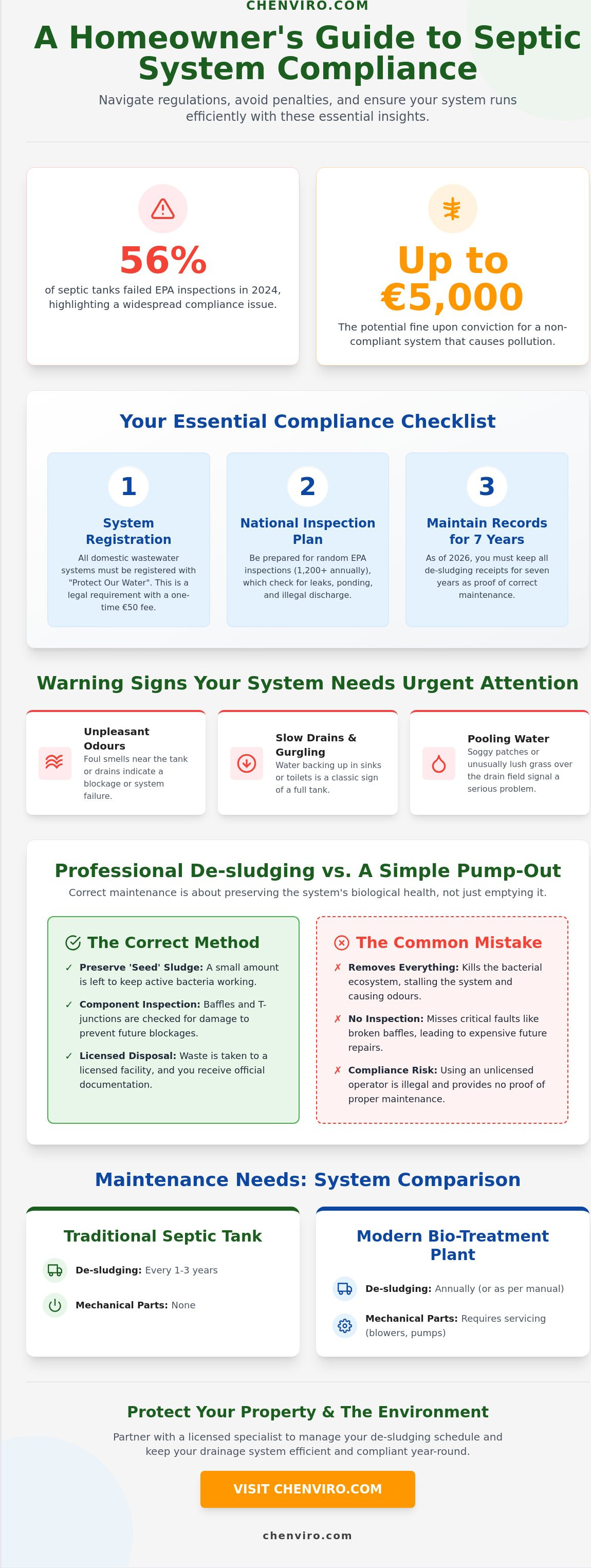
Did you know that 56% of septic tanks inspected by the EPA in 2024 failed to meet the required standards? This statistic is a wake-up call for homeowners across the country. It's understandable if you feel a sense of dread when thinking about your drainage system. Between the fear of heavy fines reaching up to €5,000 and the frustration of unpleasant odours ruining your garden, worrying about septic tank cleaning Ireland schedules often feels like a constant headache. You want a system that works efficiently without the stress of regulatory inspections hanging over your head.
This guide will show you how to master the essentials of maintenance and ensure your home stays fully compliant with the latest European Union (Water Policy) Regulations 2026. By following these steps, you can secure a foul-free, efficient drainage system that protects both your property value and the local environment. We'll walk you through the new seven-year record-keeping rules, explain how to avoid common inspection pitfalls, and help you establish a reliable schedule for professional cleaning that you can depend on for long-term peace of mind.
Table of Contents
Understanding Septic Tank Compliance and Regulations in Ireland
Owning a home in rural Ireland comes with specific responsibilities that go far beneath the surface. The Water Services (Amendment) Act provides the legal framework for how domestic wastewater systems must be managed. It's easy to adopt an "out of sight, out of mind" attitude toward your drainage, but this approach often leads to severe financial and legal consequences. To understand why these rules exist, it helps to look at the technical basics of how septic tanks work. These systems rely on a delicate biological balance to treat waste safely before it enters the groundwater. When that balance fails due to neglect, the environmental impact can be devastating for your local community.
Legal compliance isn't optional. If your system causes pollution or fails an inspection, you could face a fine of up to €5,000 upon conviction. Beyond the fines, a malfunctioning tank can devalue your property and create health hazards for your family. You must ensure that every de-sludging event is handled by a contractor holding a valid National Waste Collection Permit Office (NWCPO) permit. Hiring an unauthorised person to empty your tank is illegal. Using a professional service for septic tank cleaning Ireland ensures that your waste is disposed of at a licensed facility, and you'll receive the necessary waste transfer notes to prove your compliance.
The National Inspection Plan: What Homeowners Must Know
The EPA oversees the National Inspection Plan, which requires local authorities to carry out at least 1,200 inspections every year. You won't always get a warning that your area has been prioritised. Inspectors typically focus on regions where septic tanks might pose a risk to rivers, lakes, or private wells. During an inspection, they look for very specific red flags like leaks, surface ponding, or evidence of greywater discharging into ditches. As a property owner, you have a "Duty of Care" to ensure your system doesn't endanger human health or the environment. If an inspector finds a fault, they will issue an Advisory Notice detailing the required repairs.
Registration and Record Keeping
Every domestic wastewater treatment system in Ireland must be registered with "Protect Our Water." This involves a one-time fee of €50. If you haven't registered yet, you should do so immediately to avoid legal friction. Documentation is your best defence during an EPA visit. While previous rules were more relaxed, the European Union (Water Policy) Regulations 2026 now require you to keep receipts and records of all de-sludging activities for a full seven years. This evidence proves you are maintaining the system correctly. For a detailed breakdown of your requirements, consult our Septic Tank Compliance in Ireland: The 2026 Homeowner’s Checklist to ensure nothing is missed.
The Professional Septic Tank Cleaning Process: Beyond Emptying
Many homeowners assume that emptying a tank is a simple matter of sucking out the contents. It isn't. A basic "pump-out" often leaves behind hardened sludge and fails to address the underlying health of the system. Professional septic tank cleaning Ireland involves a methodical approach called de-sludging. This process requires leaving a small amount of "seed" sludge at the bottom. This material contains the active bacteria necessary to restart the biological breakdown of waste immediately. Removing every drop of liquid actually stalls the system, leading to foul odours and poor drainage in the weeks following the service.
A professional visit also includes a visual inspection of the tank's internal components. We check the T-junctions and baffles to ensure they are structurally sound. These parts are critical because they prevent solid waste from escaping the tank and entering the percolation area. If a baffle is cracked or missing, your soakaway will quickly become clogged with solids, leading to a system failure that costs thousands to repair. We look for signs of corrosion or thinning in the tank walls to catch potential leaks before they become environmental hazards.
Step-by-Step: What Happens During a CH Enviro Visit
Our team begins with a thorough site assessment. We check for safe access to the tank covers and evaluate the surrounding ground for signs of saturation. Once the covers are removed, we monitor the tank levels whilst carefully extracting the waste. We don't just clear the liquid; we use specialised tools to scrape and clean the tank walls and floor. This removes the hardened "scum" layers that a basic vacuum might miss. Every step is designed to restore the tank's full capacity whilst protecting the delicate pipework.
The Importance of High-Pressure Jetting
Cleaning the tank itself is only half the job. We use high-pressure water jetting to clear the inlet pipe running from your house to the tank. This prevents the slow drains and gurgling sounds that often signal a pending back-up. Jetting also ensures that the outlet pipe leading to the soakaway is clear. This process is incredibly effective at identifying hidden issues amongst older pipework, such as root intrusions or structural cracks that aren't visible from the surface. By ensuring the percolation area receives only clear effluent, we extend the life of your entire system. If you haven't had your lines cleared recently, booking a comprehensive septic tank cleaning service is the best way to prevent emergency blockages.
Septic Tank vs. Bio-Treatment Plants: Maintenance Differences
Traditional septic tanks have served Irish homes for decades, but modern environmental standards often require secondary treatment systems, commonly known as bio-treatment plants. These systems produce a much cleaner effluent, yet they come with a more complex set of maintenance requirements. Unlike a standard tank that relies on passive anaerobic bacteria, a bio-treatment plant uses mechanical aeration to support aerobic bacteria. This active process breaks down waste more efficiently, making it safer for the local water table. However, it also means the system is far more sensitive to neglect.
Professional septic tank cleaning Ireland remains essential for both types, but the scope of work changes depending on the technology. A traditional tank is largely a "set and forget" system between de-sludging intervals. In contrast, a bio-treatment plant is a living machine. Over a 10-year period, the cost of maintaining a bio-treatment plant is generally higher. You must factor in constant electricity usage, annual mechanical servicing, and the eventual replacement of blowers or pumps. While the traditional tank is cheaper to run, it is more likely to fail modern EPA inspections if the percolation area is old or undersized.
Managing Mechanical Components
A bio-treatment plant relies on air pumps and blowers to keep the aerobic bacteria alive. If the blower fails, the oxygen levels drop and the beneficial bacteria die off rapidly. This leads to a foul "rotten egg" odour and a total system failure within days. Most modern units include an alarm panel located in the house or garage. Never ignore a buzzing alarm or a red light. Power outages also pose a risk; whilst a short outage is usually fine, a prolonged loss of power will stall the treatment process. Regular oversight ensures that motors and pumps are clear of debris and functioning at peak efficiency.
Which System Do You Have?
If you have recently purchased a rural property, you might be unsure which system is buried in your garden. Traditional tanks usually have one or two heavy concrete or cast-iron lids. Bio-treatment plants often have larger, green plastic covers and a nearby control box or air vent. Common brands found amongst Irish homes include Klargester, Tricel, and BioCycle. Each has specific service requirements, particularly regarding the internal media filters and pump settings. Knowing your system type is the first step in creating a legal maintenance schedule. For more detail on timing, see our guide on How Often to Empty Your Septic Tank in Ireland: The 2026 Homeowner’s Guide to keep your property compliant.
Warning Signs Your Septic Tank Needs Urgent Cleaning
Don't wait for a total system failure before you think about septic tank cleaning Ireland services. A toilet backup is a messy disaster, but your drainage system usually provides several warnings before it reaches that stage. Recognising these signs early saves you from the massive expense of a full percolation area replacement. If you ignore the subtle hints your plumbing is giving you, the eventual repair bill will be far higher than a simple maintenance visit.
Internal vs. External Red Flags
Inside the house, listen for gurgling sounds in the pipes when you flush the toilet or run the washing machine. This often means the air cannot escape the tank because the liquid levels are too high. Slow-draining sinks and showers are another classic indicator. If these symptoms persist, your tank is likely over-capacity. A thick "scum" layer has probably formed at the top, and it's now threatening to clog the outlet pipe that leads to your soakaway.
Outside, the signs are even more obvious. You might notice a persistent "rotten egg" smell near the tank covers or the percolation area. This is hydrogen sulphide gas, a byproduct of waste that isn't being treated correctly. Look at your grass. Whilst a healthy lawn is nice, patches of lush, vibrant green grass specifically over the soakaway are a major red flag. It means the soil is being over-fertilised by raw effluent that hasn't been filtered. In the worst cases, you'll see "ponding" or pooling water on the surface. This indicates the ground is saturated and can no longer absorb any more liquid, leading to a high risk of surface water contamination in your garden.
The Impact of Heavy Rain in Ireland
Irish winters put immense pressure on drainage systems. Heavy rainfall can cause the water table to rise, which may flood an older tank or prevent it from discharging effluent. This is a particular problem amongst homes in Dublin and Meath, where heavy clay soils naturally retain more moisture. Clay doesn't drain as quickly as sandy soil, so these areas require much more vigilant monitoring. If your tank floods during a storm, don't try to pump it out whilst the ground is still sodden. The pressure from the surrounding wet soil could cause a plastic tank to pop out of the ground or a concrete one to crack.
Managing these risks requires a proactive approach rather than waiting for a crisis. If you've noticed any of these red flags, professional septic tank cleaning Ireland is the only way to restore your system's health. You can prevent environmental damage and keep your property safe by booking a septic tank cleaning service today.
Why Choose CH Enviro for Septic Tank Services in Leinster
Selecting a provider for septic tank cleaning Ireland homeowners can rely on is about more than just finding a vacuum tanker. It's about finding a local expert who understands the specific environmental challenges of the Leinster landscape. At CH Enviro, we've built our reputation on a foundation of honesty, efficiency, and deep technical knowledge. We operate extensively throughout Dublin, Meath, Kildare, and Wicklow, providing a service that's as dependable as it is professional. You won't find any hyperbolic marketing here; we're straight-shooters who value your time and your property's safety.
Our approach is built on transparency. We provide clear pricing without hidden fees or confusing jargon. When you book a service with us, you're getting a fully permitted waste collection that meets every legal requirement set by the NWCPO. This isn't just about avoiding legal trouble; it's about ensuring your waste is handled responsibly at authorised facilities. Because we offer a suite of integrated drainage solutions, we can go beyond a simple de-sludging. If we suspect structural damage during the process, we can deploy a CCTV Drain Survey or perform a No-Dig Drain Repair immediately. Whilst we are on-site, we can also assess your grease traps or wastewater treatment units to ensure total system health.
Local Service, Professional Standards
We understand that a failing septic tank is a high-stress situation. That's why we prioritise rapid response times for emergency de-sludging, particularly for our clients amongst the rural communities of the midlands. Our "no-fluff" approach means we don't just fix the immediate symptom. We investigate the cause and explain it to you in plain English. We don't guess; we verify. For residents looking for specialised care in their local area, we provide dedicated Septic Tank Cleaning Services in Kildare and Meath.
Total Drainage Peace of Mind
Documentation is your best friend when the EPA comes calling. We provide all the necessary waste transfer notes and service records you need to prove your seven-year compliance history as required by the 2026 regulations. By combining our cleaning services with routine inspections, we help you identify small issues before they become catastrophic failures. Our goal is to leave you with a system that works perfectly and the confidence that you're meeting all your legal obligations. Don't leave your property's health to chance. Contact CH Enviro today for professional septic tank cleaning in Ireland.
Secure Your Home’s Drainage Future Today
Managing a septic system doesn't have to be a source of constant worry. By staying ahead of the 2026 EPA regulations and recognising early warning signs like gurgling pipes or garden odours, you protect your home’s value and the local environment. A proactive approach to septic tank cleaning Ireland ensures your system remains compliant with the new seven-year record-keeping rules whilst preventing the massive expense of a failed percolation area. Professional maintenance is your best defence against the stress of an unexpected inspection.
As an NWCPO permitted waste collector, CH Enviro provides the reliable, straight-talking support you need to keep your drains flowing. We offer emergency 24/7 drainage support across Dublin, Meath, Kildare, and Wicklow, ensuring that expert help is always within reach. Whether you need a scheduled de-sludging or a detailed CCTV survey, our team delivers results without the fluff. Book Your Professional Septic Tank Cleaning with CH Enviro today and enjoy the peace of mind that comes with a perfectly maintained system. Your garden and your wallet will thank you.
Frequently Asked Questions
How often should I empty my septic tank in Ireland?
You should empty your septic tank at least once every one to two years. The exact frequency depends on the size of your household and the capacity of the tank. Regular de-sludging prevents the buildup of solids that can otherwise clog your percolation area and lead to a total system failure.
What is the average cost of septic tank cleaning in Dublin and Meath?
Costs vary depending on the volume of sludge and your specific location within the county. Homeowners in Dublin and Meath often face different rates due to local disposal facility fees and the distance the tanker must travel. Always ensure you receive a clear quote from a permitted contractor that includes the legal disposal of waste.
Can I use additives to avoid cleaning my septic tank?
No, additives cannot replace the need for physical cleaning. Whilst some products might help maintain the bacterial balance, they don't remove the inorganic solids and sludge that accumulate at the bottom of the tank. Relying solely on additives will eventually lead to a blocked soakaway and expensive repairs.
What happens if my septic tank fails an EPA inspection?
You will be issued an Advisory Notice detailing the specific faults found during the inspection. This notice is a legal requirement to repair or maintain your system within a set timeframe. Failure to comply with these instructions can result in significant legal action and fines of up to €5,000.
Can heavy rain cause my septic tank to smell or overflow?
Yes, intense rainfall can raise the local water table and saturate the ground around your soakaway. This prevents effluent from draining away, which causes the tank to back up and produce foul odours. If your system overflows during wet weather, it's a sign that your drainage capacity is struggling and needs professional attention.
How do I know if my septic tank is registered and compliant?
You can check your registration status on the "Protect Our Water" official portal. To be fully compliant, you must also maintain a record of your septic tank cleaning Ireland services. Under the 2026 regulations, you're legally required to keep these receipts and waste transfer notes for at least seven years.
What should I never flush into my septic tank system?
Avoid flushing wet wipes, even those labelled as "flushable," as well as fats, oils, and grease. These materials don't break down and will quickly block your tank's baffles. You should also avoid pouring harsh chemicals or large amounts of bleach down the drain, as these kill the bacteria responsible for treating the waste.
Do I need a CCTV survey when getting my septic tank cleaned?
A CCTV survey isn't always mandatory, but it's highly recommended if you're experiencing recurring blockages or slow drains. Whilst a standard clean removes the waste, a camera inspection is the only way to identify hidden issues like root intrusions or structural cracks. It provides a definitive look at the health of your underground pipes.


Comments