
Grease trap waste disposal certificates and inspector requirements
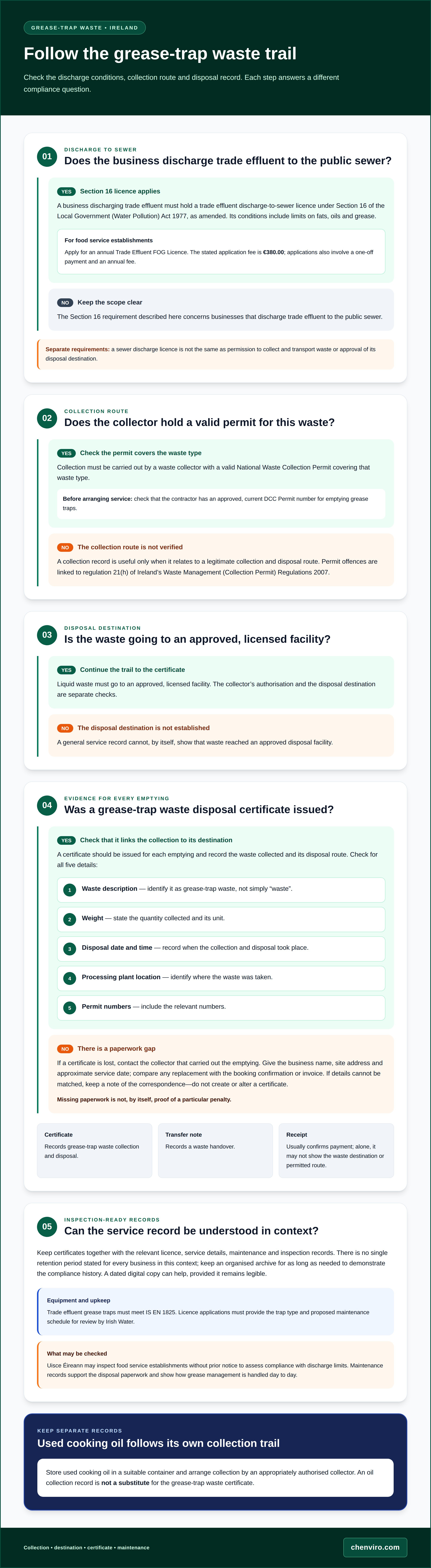
A grease trap disposal record needs to show more than that a collection took place. Each time a trap is emptied, a grease trap waste disposal certificate should be issued, recording the waste description and weight, the disposal date and time, the processing plant location and permit numbers. Those details give an inspector a clear trail from collection to disposal, alongside the business’s grease-trap maintenance records.
Before an inspection, keep the grease trap waste disposal certificate, service details and records together, and make sure they accurately reflect the collection. This guide explains what an inspector may review, what information belongs on the certificate and how grease-trap waste disposal differs from used cooking oil collection in Ireland. It also shows how cleaning and maintenance records support day-to-day grease management.
Table of Contents
Licensed liquid waste disposal facilities
For grease-trap trade effluent, the key legal requirement concerns discharge to the public sewer. A business that discharges trade effluent must hold a trade effluent discharge-to-sewer licence under Section 16 of the Local Government (Water Pollution) Act 1977, as amended. The licence sets conditions for what may enter the sewer, including limits on fats, oils and grease. It is separate from the permission needed to collect and transport waste.
Liquid waste must go to an approved, licensed facility, and collection must be carried out by a waste collector with a valid National Waste Collection Permit covering that waste type. These are separate requirements: permission to discharge effluent, authorisation to collect waste and an approved disposal destination. A collection record is useful only when it relates to a legitimate collection and disposal route.
The offences connected with collection permits have a specific legal reference. The Law Reform Commission of Ireland links offences under the relevant section to regulation 21(h) of Ireland’s Waste Management (Collection Permit) Regulations 2007. This reinforces why a permit number and the type of waste covered matter when a business arranges collection.
Food service establishments must apply for an annual Trade Effluent FOG Licence. Its conditions limit the fats, oils and grease discharged to the public drainage system. A grease management system must therefore control effluent output in line with the business’s licence, rather than treating trap emptying as the only compliance task. The stated application fee for the Trade Effluent FOG Licence is €380.00. Trade effluent licence applications also involve a one-off payment and an annual fee.
Local requirements can add practical oversight. Some city and county councils run Fats, Oils and Greases management programmes for food service establishments. Uisce Éireann operates and maintains public sewers, including clearing blockages caused by fats, oils and grease. The business or property owner is responsible for private drains connecting the premises to the public sewer. Uisce Éireann may inspect food service establishments without prior notice to assess compliance with discharge limits.
Grease-trap design and maintenance also support licence compliance. Trade effluent grease traps must meet IS EN 1825, and licence applications must provide the trap type and proposed maintenance schedule for review by Irish Water. Together, these requirements connect the equipment on site with the discharge conditions and the waste collection route. Keep the licence conditions, equipment details and service records organised so the disposal paperwork can be understood in context.
Waste disposal certificates
A waste disposal certificate records what happened when a grease trap was emptied. It should be issued for each emptying and document the collection and disposal route. This is more useful than a general invoice because it connects a specific service with the waste removed and its destination.
A certificate, waste transfer note and receipt have different purposes. The certificate records details of grease-trap waste collection and disposal. A transfer note records a waste handover, while a receipt usually confirms payment for a transaction or service. A receipt alone may not show where the waste went or which permitted collection route was used.
There is no single retention period that applies to every business record in this context. Keep certificates in an organised archive with relevant licence, maintenance and inspection records, and retain them for as long as needed to demonstrate the business’s compliance history. A dated digital copy can make past collections easier to retrieve, provided the details remain legible.
Missing paperwork can leave a gap in the evidence that waste was collected and handled appropriately. Improper disposal also creates environmental risks: fats, oils and grease can build up in pipes, contribute to blockages and lead to sewage overflowing into business premises or public areas. Collection-permit offences are linked to regulation 21(h) of Ireland’s Waste Management (Collection Permit) Regulations 2007. The specific consequences depend on the circumstances and applicable enforcement; a missing certificate should not be treated as proof of a particular penalty.
If you lose a certificate, contact the waste collector that carried out the emptying and request a replacement. Provide the business name, site address and approximate service date so the collection can be identified. Compare the replacement with any booking confirmation or invoice, then file it with that service’s records. If the collection details cannot be matched, keep a note of the correspondence rather than creating or altering a certificate yourself.
Used cooking oil needs its own clear collection trail. Store it in a suitable container and arrange collection by an appropriately authorised collector; don’t treat an oil collection record as a substitute for the grease-trap certificate. For a regular service record that fits the trap’s maintenance needs, grease trap cleaning and maintenance can support consistent upkeep and documentation.
Before arranging a service, check that the contractor has an approved, current DCC Permit number for emptying grease traps.
Information to include on a certificate
A useful certificate links a specific grease-trap emptying to the waste collected and its destination. It should identify the waste description, weight, disposal date and time, processing plant location and permit numbers. Together, these details let the reader follow the recorded collection from the premises to processing, rather than relying on a general service receipt.
Waste description: identify the material as grease-trap waste, not simply “waste”.
Weight: record the quantity collected, with its unit clearly shown.
Disposal date and time: state when the collection and disposal took place.
Processing plant location: identify where the collected waste was taken.
Permit numbers: include the relevant numbers for the collection and disposal route.
Each field answers a different question. The waste description distinguishes trap contents from other materials, such as used cooking oil. The weight records the amount handled. The date and time connect the paperwork to a specific service visit, while the plant location identifies the stated destination. Permit numbers help identify the authorised waste route.
Check that the details form one consistent record. For example, the waste description, collection time and processing plant location should all relate to the same service. A weight without a unit is difficult to interpret, and a date without a time gives less detail about when the job took place. Clear entries help avoid confusion between separate collections at the same premises.
The contractor’s permit details matter because the certificate records more than removal from the trap. It should make the collection and disposal route clear. If the paperwork includes several permit numbers, each should be legible and clearly linked to the relevant stage. Do not rely on an unclear scan or a handwritten correction that obscures the original information.
File the certificate with the premises details and the corresponding service visit. A site reference or booking record can help distinguish locations served by the same business. These supporting references make the certificate easier to retrieve, but do not replace its waste description, weight, disposal date and time, plant location or permit numbers.
Before filing, make sure all five core details are legible and relate to the same collection. If any field is missing or unclear, ask the contractor to clarify the record. Keep the certificate with the grease-trap maintenance history so an inspector can see how the collection fits the system’s servicing pattern.
CH Enviro: Grease Trap Cleaning & Maintenance
CH Enviro provides grease trap cleaning and maintenance for businesses that need their equipment serviced. This is relevant when a trap needs attention or its servicing schedule needs to be reviewed alongside trade effluent requirements. Organised service records help explain how the equipment is maintained, while disposal paperwork documents the waste collection and destination.
If blockages affect the drainage system, a drain unblocking service may address that separate issue. A CCTV drain survey can help investigate drain condition where an inspection is needed. For help with grease trap cleaning and maintenance, contact CH Enviro.
Keep the next service visit on track
Make the paperwork part of your maintenance routine. File each grease trap waste disposal certificate with the relevant site record, then use the history when planning future servicing or reviewing changes in kitchen operations. Consistent records make it easier to assess whether the system’s upkeep still suits the premises.
If a blockage or wider drainage concern arises alongside grease-trap maintenance, CH Enviro also provides drain unblocking, CCTV drain surveys and no-dig drain repair. These services address related drainage needs, while the disposal certificate remains a record of the waste collection and destination.
For support with grease-trap cleaning and maintenance, contact CH Enviro about your waste disposal needs. A clear next step can help you keep maintenance and records moving in the right direction.
Frequently Asked Questions
What Does the Inspector Require?
An inspector may check whether the business follows its trade effluent licence conditions and manages grease-trap equipment accordingly. Uisce Éireann may inspect food service establishments without prior notice to check discharge limits. For a Dublin kitchen, keep relevant licence and maintenance records together so the inspector can understand how the trap is managed and how servicing relates to the site’s discharge controls.
What is a grease trap waste disposal certificate in Ireland?
A grease trap waste disposal certificate records an emptying and the waste’s disposal route. It connects a specific service visit with the waste collected and its processing destination. For example, a restaurant can file the certificate alongside that visit’s maintenance record, keeping the trap collection distinct from a separate used cooking oil collection.
What information must a grease trap waste disposal certificate include?
The certificate should identify the waste description, weight, disposal date and time, processing plant location and relevant permit numbers. Check that the details clearly relate to one collection. For example, the description should identify grease-trap contents, and the recorded weight should include a unit. Clear, consistent entries make the document easier to interpret alongside the business’s service records.
Which Irish businesses need a grease trap waste disposal certificate?
Businesses with grease traps should receive a waste disposal certificate each time a trap is emptied. This includes food service establishments that must manage grease-trap waste and maintain service records.
How often must grease trap waste be emptied and collected in Ireland?
Grease traps are recommended to be completely emptied and cleaned every 3-6 months, depending on the trap. They should also be emptied when fats, oils and grease occupy 25% of the trap’s capacity.
What are the penalties for improper grease trap waste disposal or missing certificates?
Improper disposal can cause blockages and sewage overflows, and collection-permit offences are linked to regulation 21(h) of Ireland’s Waste Management (Collection Permit) Regulations 2007. Consequences depend on the circumstances and applicable enforcement.
Comments