
The Essential Guide to Facility Maintenance in Dublin: Protecting Your Property’s Infrastructure
Updated: Jun 26
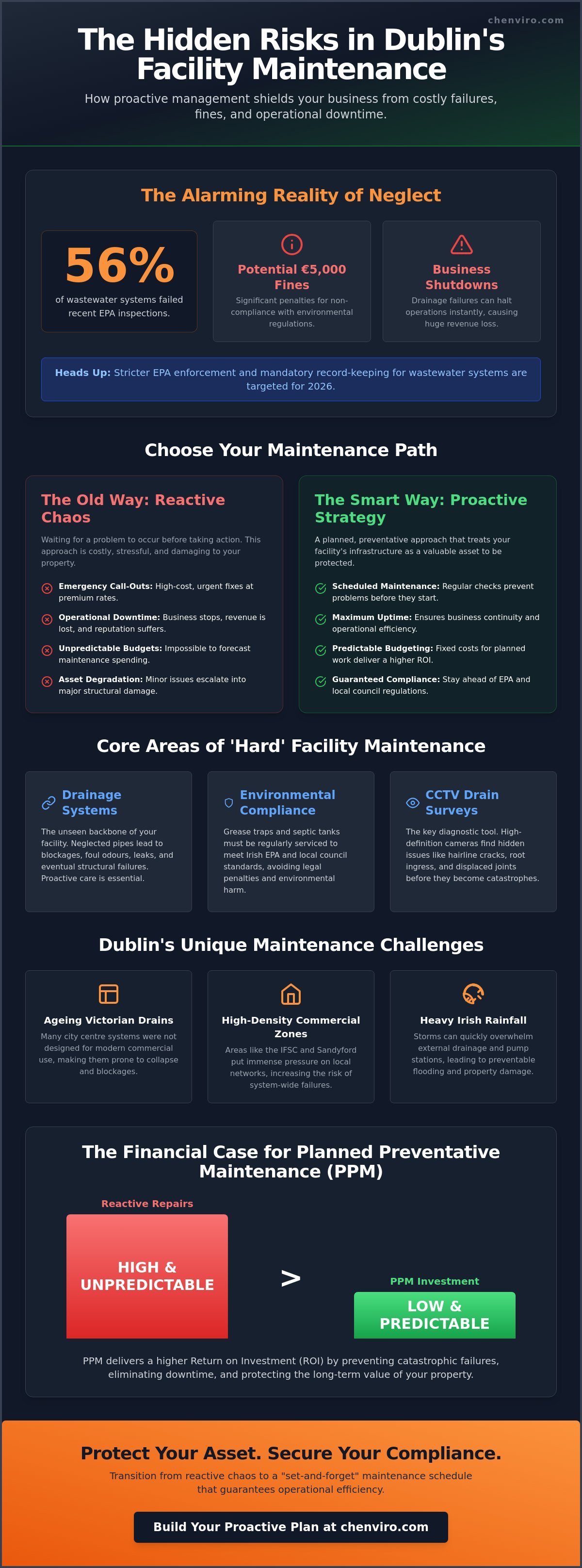
Did you know that 56% of wastewater treatment systems inspected by the EPA recently failed to meet required standards? For many property managers, these statistics aren't just data points; they represent the constant anxiety of a potential €5,000 fine or a sudden, business-stopping drainage failure. Managing the facility maintenance Dublin businesses require often feels like a cycle of chasing unreliable contractors and hoping your infrastructure holds up for another week. It's a stressful way to operate, especially with the 2026 focus on stricter environmental enforcement and mandatory record-keeping for wastewater systems.
You shouldn't have to worry about what's happening beneath the ground while you're trying to run a company above it. This guide will show you how to move away from reactive chaos and toward a "set-and-forget" maintenance schedule that guarantees operational efficiency. We'll explore the essential steps to ensure full regulatory compliance for your wastewater and grease management systems. You'll learn how to protect your property's long-term value through proactive drainage care and reliable emergency response planning.
Table of Contents
The Strategic Importance of Facility Maintenance in Dublin
Effective facility maintenance Dublin property owners rely on is about more than just keeping a building looking tidy, though ensuring a pristine environment through commercial cleaning services Bristol is a vital part of the broader Soft FM picture. It's a strategic discipline that balances the needs of modern commercial hubs with the realities of aging subterranean infrastructure. Whether you manage a retail unit in the city centre or a sprawling industrial warehouse in South Dublin, your maintenance strategy directly impacts your bottom line. Traditional methods often relied on reactive fixes, essentially waiting for something to break before calling a contractor. Today, the industry has shifted toward proactive asset management. This approach treats your property’s infrastructure as a vital investment that needs constant, planned protection rather than occasional emergency repairs.
The cost of neglect in this area is rarely just the price of a repair. A minor blockage in a primary drainage line can escalate into significant structural dampness or a total business shutdown within hours. In a city where commercial space is at a premium, downtime is a luxury few can afford. By implementing a structured maintenance plan, you aren't just fixing pipes; you're ensuring the continuity of your operations and the safety of everyone on-site.
The Core Components of Modern Facility Management
Professional Facility management is generally split into two categories: Hard FM and Soft FM. Soft FM covers services like cleaning and security, whilst Hard FM focuses on the physical fabric of the building itself. Drainage and plumbing form the absolute backbone of Hard FM. If these systems fail, the building becomes unusable. Integrating environmental services into this mix, such as regular grease trap servicing or wastewater monitoring, is now essential for sustainable property management and legal compliance in Ireland.
Local Challenges for Dublin Property Owners
Dublin presents a unique set of challenges that require a specialised touch. In the city centre, many businesses still rely on Victorian-era drainage systems that were never designed for current usage levels. High-density commercial zones like the IFSC or Sandyford put immense pressure on local networks, making facility maintenance Dublin services even more critical. Our local climate also plays a major role. Heavy Irish rainfall can quickly overwhelm external drainage and pump stations. Without regular inspections and desilting, these systems can fail during a storm, leading to preventable flooding and expensive property damage. Understanding these local nuances is the difference between a generic service and a truly effective maintenance partnership.
Critical Drainage and Infrastructure Maintenance
Drainage systems are the most frequently ignored aspect of facility maintenance Dublin property owners manage. Whilst painting walls or servicing lifts is visible, the network of pipes beneath the concrete is what keeps the facility operational. Neglect here isn't just a minor oversight; it's a structural risk. Investing in professional drainage services in Dublin ensures that these hidden assets remain in peak condition, preventing the catastrophic failures that lead to expensive downtime. It's about protecting the building from the ground up.
The importance of maintaining drainage infrastructure cannot be overstated. When stormwater or foul systems are left to accumulate silt and debris, the hydraulic capacity of the network drops. This increases the pressure on pipe joints and seals, eventually leading to leaks or collapses. A proactive approach identifies these issues before they manifest as a flooded basement or a foul-smelling lobby. By using modern diagnostic tools, you can manage your infrastructure with data rather than guesswork.
CCTV Drain Surveys: The Maintenance Manager’s Best Friend
A CCTV drain survey in Dublin is the most effective diagnostic tool available to facility managers. It removes the mystery by providing a high-definition view of the pipe's interior. We look for specific structural defects like hairline cracks, root ingress from nearby landscaping, or displaced joints. This process generates a transparent audit trail. If you ever need to make an insurance claim for structural damage, having a dated, professional report of your drainage health is invaluable. It proves you've met your duty of care as a property owner and provides a clear roadmap for any necessary repairs.
No-Dig Drain Repair: Efficiency Without the Disruption
Traditionally, fixing a collapsed pipe meant excavating the site, which is noisy, messy, and incredibly slow. For high-traffic retail or industrial environments, this isn't an option. No-dig drain repair in Dublin has changed the landscape of property maintenance. By using advanced pipe relining and patch repair techniques, we can restore the structural integrity of a pipe from the inside. This trenchless technology minimises site disruption, allowing your business to continue as normal whilst we work. It’s a faster, cleaner, and often more cost-effective solution for modern facilities. If you suspect your infrastructure is compromised, it's worth booking a professional assessment before the issue worsens.
Navigating Environmental Compliance: Septic Tanks and Grease Traps
Environmental compliance isn't just a box-ticking exercise; it's a legal and ethical obligation for every property manager in the capital. Within the scope of facility maintenance Dublin authorities have become increasingly strict regarding how businesses manage their liquid waste. Failure to comply doesn't just risk environmental damage; it leads to heavy fines and potential closure. Central to this is understanding the Trade Effluent Licence requirements. If your business discharges anything other than domestic sewage into the public sewer, such as catering waste or industrial runoff, you must have this licence in place. In Dublin, the one-off application fee for this licence is currently €380.00, a small price to pay compared to the penalties for non-compliance.
Documentation is your strongest defence during an environmental audit. Every time a grease trap is emptied or a septic tank is desludged, you must receive and store a certificate of disposal from a permitted waste collector. Under the European Union (Water Policy) Regulations 2026, property owners are legally required to keep records of septic tank desludging for seven years. If an inspector from the EPA or Dublin City Council arrives at your premises, these records are the only way to prove you've fulfilled your legal duties. A "set-and-forget" maintenance schedule ensures these tasks are completed and documented without you having to track the dates yourself.
Grease Trap Management for the Dublin Hospitality Sector
For Dublin’s hospitality sector, grease management is a daily operational reality. Fats, oils, and grease (FOG) that enter the sewer system create "fatbergs" that cause massive blockages and environmental contamination. It is a legal requirement for grease traps in Food Service Establishments to be cleaned four times a year. However, high-volume kitchens in the city centre often require a more frequent programme to prevent overflows. Integrating grease management into your wider facility contract ensures cleaning happens automatically, preventing the foul odours and drainage backups that can ruin a customer's experience.
Septic Tank and Wastewater Treatment Maintenance
Rural facilities and properties on the outskirts of Dublin often rely on independent wastewater systems. These are under intense scrutiny, with the National Inspection Plan requiring a minimum of 1,200 inspections annually through 2026. Given that 56% of systems failed EPA inspections in 2024, proactive care is essential. This includes regular desludging and ensuring your mechanical components are functional. It's particularly important to invest in expert pump station repair in Ireland if your system relies on pumps to move waste. Signs like slow drainage, pooling water, or unusual odours near the tank suggest your system needs urgent professional attention before it fails a mandatory inspection.
Planned Preventative Maintenance vs. Reactive Repairs
Waiting for a system failure is the most expensive way to manage a property. Whilst emergency services are vital when a crisis occurs, relying on them as your primary strategy is a recipe for financial volatility. Effective facility maintenance Dublin providers offer isn't just about answering the phone when a pipe bursts. It's about ensuring the pipe never bursts in the first place. For commercial landlords, the Return on Investment (ROI) of Planned Preventative Maintenance (PPM) is clear. You avoid the inflated costs of emergency call-outs and, more importantly, you protect the reputation of your building.
A custom maintenance schedule allows you to organise high-impact work during off-peak hours. This reduces the "stress factor" for both facility managers and tenants. When a tenant knows that drainage, grease management, and wastewater systems are being monitored, they feel more secure in their lease. Proactive care transforms your maintenance budget from an unpredictable burden into a manageable, fixed operational cost.
The Hidden Costs of "Break-Fix" Maintenance
The "break-fix" model carries several invisible costs that quickly add up. When you operate reactively, you are always paying a premium for urgency. Consider these factors:
Premium Rates: Emergency call-out fees and out-of-hours hourly rates are significantly higher than scheduled service fees.
Business Interruption: An unplanned drainage failure in a retail centre or office block can lead to hours or days of lost revenue.
Asset Depreciation: Neglected infrastructure wears out faster. A system that is cleaned and inspected regularly can last years longer than one left to deteriorate.
Safety Hazards: Overfowing sewage or blocked fire exits due to maintenance neglect create immediate health and safety risks.
Vermin Control: A Critical Part of the Maintenance Puzzle
Many property owners don't realise that their drainage system is the primary highway for pests. In Dublin's older districts, structural defects in pipes are the number one entry point for rodents. A truly integrated facility maintenance Dublin programme connects your drainage health with your Vermin Control Service. By identifying and repairing cracks or displaced joints through regular inspections, you create a physical barrier against infestation. This is especially vital in food-sensitive environments like restaurants or food processing plants, where a single pest sighting can result in an immediate closure order. Proactive pest management is far more effective than trying to handle an infestation after it has already taken hold.
If you want to move away from the chaos of reactive repairs and secure your property’s future, contact us today to discuss a tailored maintenance programme.
Choosing the Right Facility Maintenance Partner in Dublin
Selecting a partner for the facility maintenance Dublin properties require is a decision that directly affects your building's long-term health. You need more than just a handyman with a toolkit; you need a specialist who understands the complex relationship between a building's structure and its environmental systems. A key factor in your evaluation should be technical self-sufficiency. Ask if the provider owns their own specialised drainage equipment. Companies that own their fleet and diagnostic tools can respond faster and provide more consistent results than those who rely on subcontractors. When a crisis occurs, you don't want to be third on a sub-hiring list.
Local knowledge is another indispensable asset. Infrastructure in Dublin city centre differs vastly from the systems found in Meath or Kildare. A partner familiar with the Greater Dublin Regional Code of Practice for Drainage Works will ensure every repair and installation meets local standards. This regional expertise allows a provider to anticipate common issues associated with specific areas, from the aging clay pipes of older districts to the high-pressure demands of modern commercial hubs. It's about having a "straight-shooter" on your side who knows exactly what they're looking at the moment they arrive on-site.
Transparency and reporting are the hallmarks of a professional service. You should expect detailed digital reports after every inspection, especially when dealing with CCTV surveys or environmental audits. This data shouldn't be buried in jargon. It needs to be clear, actionable, and ready for your records. Having a single point of contact for all drainage and environmental needs simplifies your management process and ensures that no part of your infrastructure is overlooked during routine checks.
This need for clear, actionable data and strategic oversight is universal across all business functions; for those looking to apply the same level of professionalism to their IT infrastructure, learn more about Mytech Partners and their managed service solutions.
Essential Qualifications and Certifications
Before signing any contract, verify that the provider meets the necessary legal and safety standards. Industrial and commercial experience is a non-negotiable requirement for large sites. Ensure your partner holds the following:
Valid Waste Permits: Essential for the legal transport and disposal of grease trap waste or septic tank sludge.
Comprehensive Insurance: Protection for both the contractor and your property during complex works.
Health and Safety Protocols: Rigorous standards for working in confined spaces or high-traffic environments; partnering with Guardian Safety for specialist training ensures your team meets these critical industry requirements.
Proven Track Record: Don't be afraid to ask for case studies or references from other Dublin-based facilities.
The CH Enviro Approach to Integrated Maintenance
We believe in a grounded, dependable approach to property care. By combining deep drainage expertise with essential environmental services and light plumbing solutions, we provide a complete defence for your infrastructure. Our team remains unfazed by the most challenging blockages or compliance issues. We're committed to providing straight-talking, professional service across the entire Leinster region, ensuring your property remains efficient and compliant. If you're ready to secure your building's future, enquire about a facility maintenance contract with CH Enviro today.
Secure Your Property’s Future with Proactive Care
Transitioning from the chaos of emergency repairs to a structured maintenance plan is the most effective way to protect your commercial or residential assets. By prioritising drainage health and staying ahead of environmental regulations, you eliminate the risk of sudden business closures and expensive legal penalties. Effective facility maintenance Dublin depends on having a partner who understands the local infrastructure and owns the right tools for the job. It's about moving away from the stress of the "break-fix" cycle and toward a strategy that ensures long-term operational stability.
We bring a "no-nonsense" approach to property care, using specialist equipment like high-pressure jetting and HD CCTV cameras to keep your systems running perfectly. Our team is fully compliant with all Irish environmental and waste disposal regulations, providing you with the documentation you need for any audit. Serving Dublin, Meath, Louth, Kildare, Wicklow, and Wexford, we provide the local expertise you can depend on. Contact CH Enviro for a comprehensive facility maintenance audit in Dublin and take the first step toward a more reliable, stress-free property management strategy. Your infrastructure is the backbone of your business; give it the professional attention it deserves.
Frequently Asked Questions
What is included in a typical facility maintenance contract in Dublin?
A comprehensive contract focuses on the hard infrastructure that keeps your building operational. This typically covers periodic drain unblocking, grease trap cleaning, and CCTV surveys to monitor pipe health. It also includes environmental services like septic tank maintenance and wastewater monitoring. By integrating these services into one agreement, you ensure that facility maintenance Dublin property managers can rely on is consistent, documented, and proactive rather than purely reactive.
How often should a commercial grease trap be serviced in Ireland?
Under current Irish regulations, commercial grease traps must be cleaned at least four times a year. However, high-volume kitchens in the city centre often require more frequent servicing to prevent fatbergs and overflows. Sticking to this schedule is a legal necessity for businesses operating under a Trade Effluent Licence. Regular maintenance ensures you remain compliant with local authority standards whilst avoiding the heavy fines associated with environmental contamination.
Does my business need a CCTV drain survey for insurance purposes?
Whilst not always a mandatory requirement for every policy, a CCTV drain survey is the most effective way to provide a transparent audit trail for insurers. It provides high-definition proof of structural integrity and identifies defects like root ingress before they cause a collapse. If you need to make a claim for subsidence or water damage, having professional documentation of your drainage condition can significantly speed up the process and validate your claim.
What are the legal requirements for septic tank maintenance in Dublin?
Homeowners and businesses with septic tanks must register their systems with "Protect Our Water" and pay a registration fee. Legally, you are also required to keep records of septic tank desludging for seven years under the European Union (Water Policy) Regulations 2026. Regular cleaning is essential to prevent system failure, especially since 56% of systems failed EPA inspections in 2024. Failure to comply can result in fines of up to €5,000.
Can facility maintenance help with rodent and vermin control?
Yes, effective facility maintenance Dublin programmes often integrate vermin control by addressing the source of the problem. Most rodent infestations in urban buildings begin with structural defects in the drainage network. By identifying and fixing these entry points through CCTV surveys and no-dig repairs, we create a physical barrier that stops pests from entering your premises. This proactive approach is far more effective than simply placing traps after an infestation has started.
Is it cheaper to have a planned maintenance contract or pay as I go?
A planned maintenance contract is almost always more cost-effective than a reactive "pay as you go" model. Reactive repairs involve emergency call-out fees, higher hourly rates, and the hidden costs of business downtime. A planned schedule allows you to budget for fixed costs and catch minor issues before they become catastrophic failures. It also extends the lifespan of your infrastructure, delivering a much higher return on investment for commercial landlords.
What areas of Leinster do you cover for facility maintenance?
We provide comprehensive facility maintenance services across the entire Leinster region. This includes primary coverage in Dublin, Meath, and Louth, as well as Kildare, Wicklow, and Wexford. Our team has extensive experience navigating the specific infrastructure challenges unique to these areas, from the historic pipes of old Dublin to the modern pump stations in newer developments. This regional knowledge ensures that our solutions are always appropriate for your specific location.
How quickly can a facility maintenance provider respond to an emergency in Dublin?
Response times for emergencies depend on the nature of the failure and the location of the site. Most professional providers in the Dublin region aim to prioritise urgent drainage or plumbing failures to minimise business disruption and safety risks. Whilst specific timelines can vary, having a maintenance contract in place often gives you priority access to support. You should always check with your provider to understand their specific protocols for handling critical infrastructure emergencies.


Comments